
Dental Bridges in La Habra, CA
Dental bridges in La Habra replace one or more missing teeth with a fixed restoration that stays anchored in place, day and night. Summit Smiles cements each bridge to the natural teeth or dental implants beside the gap, then fills the empty space with a custom-shaped pontic matched to the color of your existing teeth. Dr. Amit Shah plans and places every bridge, and Dr. Meghna Patel, our in-house endodontic specialist, treats any tooth that needs root canal care first. This page compares a bridge against a dental implant and a denture, walks through all four bridge types, and covers real cost factors, aftercare, and candidacy for patients across La Habra and Orange County.
What Is a Dental Bridge?
A dental bridge is a fixed restoration that replaces one or more missing teeth by anchoring an artificial tooth to the teeth on either side of the gap. The restoration has three working parts: two crowns, called abutments, that cement onto the natural teeth or dental implants next to the space, and a pontic, the false tooth that spans the gap between them. Dentists shape and shade every pontic to match your natural teeth, so it restores your bite and your appearance at the same time. A bridge never comes out on its own. It stays cemented in place and functions like your own teeth for chewing and speaking. Summit Smiles places four types of bridges: traditional, cantilever, Maryland, and implant-supported, each suited to a different gap and a different set of neighboring teeth. Porcelain, metal, and porcelain-fused-to-metal are the three material choices, and each affects strength, color match, and cost.
Medically reviewed by Dr. Manali Shah, DDS · UCLA School of Dentistry · Last reviewed September 2026.
Bridge vs. Implant vs. Denture: Which Is Right for You?
A dental bridge, a dental implant, and a denture each replace missing teeth, but they differ in surgery, timeline, and candidacy. A bridge needs no surgery and typically finishes in two visits. A dental implant places a titanium post directly into the jawbone and needs a healing period before a crown attaches. A denture replaces a full arch or a partial set of teeth with a removable appliance rather than a fixed one. As per Pjetursson et al. (2007, Clinical Oral Implants Research), implant-supported single crowns and conventional bridges reach comparable survival rates, roughly 94.5% and 93.8% at five years. The real difference sits in the type of complication each option tends to have. By five years, 38.7% of implant patients had experienced a mechanical or technical complication, compared with 15.7% of bridge patients, whose complications skewed toward biological issues such as decay under a crown. As stated by the American Association of Oral and Maxillofacial Surgeons, both fixed bridges and traditional dentures may need replacement every seven to fifteen years, a range that depends heavily on daily care and regular dental visits, not a fixed countdown. As per the American College of Prosthodontists, a single-tooth implant typically costs almost the same as replacing that tooth with a regular fixed bridge, so cost alone rarely settles the decision.
The table below lines up the three options side by side, using the factors patients ask about most.
| Factor | Dental Bridge | Dental Implant | Denture |
|---|---|---|---|
| Surgery required | No (unless implant-supported) | Yes | No |
| Typical visits | 2 | Multiple, over several months | 2 to 3 fittings |
| Candidacy | Needs healthy neighboring teeth (or implants) | Needs enough healthy jawbone | Fits most patients missing several teeth |
| Fixed or removable | Fixed | Fixed | Removable |
| Typical longevity | 7 to 15 years (AAOMS) | Often longer with proper care | 5 to 10 years, then relining or replacement |
Are You a Candidate for a Dental Bridge?
You are a candidate for a dental bridge if you have one or more missing teeth and healthy natural teeth, or dental implants, on at least one side of the gap. As noted by the CDC's 2024 Oral Health Surveillance Report, more than 36 million Americans have no teeth at all, and 120 million are missing at least one, so this is a common concern, not a rare one. A traditional bridge needs a healthy abutment tooth on each side of the gap. A cantilever bridge needs only one healthy neighboring tooth, which makes it an option when a gap sits at the end of a row. A Maryland bridge also needs natural teeth on both sides, but bonds a metal or porcelain framework to the back of each tooth instead of covering it with a full crown. An implant-supported bridge replaces multiple missing teeth using implants as anchors instead of natural teeth, which helps when neighboring teeth are not strong enough to support a bridge on their own. Left untreated long enough, a missing tooth can also lead to jawbone loss and visible facial sagging, one more reason most patients choose to replace a gap sooner rather than later.
Signs that a bridge may be the right next step include the following.
- One or more missing teeth that leave a visible or functional gap
- Neighboring teeth that have started shifting or tilting into the open space
- Difficulty chewing on one side of your mouth
- A change in your bite or jaw alignment since losing a tooth
- Interest in a fixed, non-removable replacement rather than implant surgery
Your Bridge Journey at Summit Smiles
Your bridge journey at Summit Smiles moves through four steps from your first visit to your finished restoration. Dr. Shah prepares the abutment teeth, captures a precise digital impression, and sends your case to a dental laboratory that fabricates your custom bridge. You wear a temporary bridge while the permanent one is made, then return for cementation and a final bite check.
Preparation. Dr. Shah numbs the area, reshapes the abutment teeth, and removes a thin layer of enamel to make room for the crowns that will anchor the bridge.
Impression and crafting. A digital scan or a physical impression captures the exact shape of your prepared teeth, and a dental laboratory fabricates your bridge to match the color and contour of your natural teeth.
Placement. Dr. Shah checks the fit, color, and bite of your new bridge, then cements it permanently to the abutment teeth.
Final adjustments. A short follow-up visit confirms your bite feels even and your bridge sits comfortably against your gum line.
Precision Technology: Digital Impressions and 3D Imaging
Precision technology at Summit Smiles starts with 3D CBCT imaging and digital intraoral scanners, used to plan and fit every dental bridge. A CBCT scan shows the bone and root structure beneath each abutment tooth, so Dr. Shah can confirm a tooth is strong enough to support a bridge before any preparation begins. A digital scanner captures an exact, comfortable impression of your prepared teeth in minutes, replacing the older putty-tray impression many patients remember from past visits. That digital file goes directly to the dental laboratory, which shortens turnaround time and improves how closely the finished bridge matches your bite and your natural tooth shape.
Life With a Dental Bridge
Life with a dental bridge returns the everyday functions a missing tooth interrupts: eating, speaking, and smiling without a second thought. A bridge restores full chewing function on both sides of your mouth, so foods you avoided while a gap was open return to your regular diet. It also holds your remaining teeth in their proper position, preventing the shifting and tilting that follows an unaddressed gap over time.
Eat what you love. A properly fitted bridge restores enough bite force to chew most foods normally within days of placement.
Speak with confidence. A gap between teeth can affect certain sounds; a bridge closes that gap and restores clear speech.
Protect your remaining teeth. A bridge keeps neighboring teeth from drifting into open space, which helps prevent the bite problems that follow untreated tooth loss.
Caring for Your Bridge: Recovery and Long-Term Success
Caring for your bridge starts the moment it is cemented and continues for as long as you wear it. Most patients feel mild sensitivity to hot or cold for a few days after placement, and this settles on its own as the abutment teeth adjust. Long-term success depends on the same daily habits that protect your natural teeth, plus a few bridge-specific steps that prevent decay from forming under the restoration.
Follow this care timeline to protect your investment in a new bridge.
Immediately After Placement: Eat soft foods for the first day and avoid chewing directly on the new bridge until any numbness wears off.
Daily Care: Brush twice a day, floss under the pontic with a floss threader or water flosser, and rinse to clear away trapped food.
Long-Term Maintenance: Keep regular dental visits so Dr. Shah can check the cement seal and the health of the abutment teeth.
When to Call Us Immediately: A loose or shifting bridge, a bad taste or odor near the gum line, or new pain in an abutment tooth.
Dental Bridge Cost in La Habra, CA
Dental bridge cost in La Habra depends on the type of bridge, the materials used, and how many teeth the bridge needs to replace. [bridge price range]. A traditional or Maryland bridge, which uses natural teeth as anchors, generally costs less than an implant-supported bridge, which adds the cost of one or more dental implants. Porcelain bridges cost more than metal or porcelain-fused-to-metal bridges, but blend in more naturally against your surrounding teeth.
What is typically included in your dental bridge investment at Summit Smiles:
- A 3D CBCT scan and digital impression of the treatment area
- Preparation of the abutment teeth and a temporary bridge while your permanent one is made
- Your custom-fabricated bridge, shaded and shaped to match your natural teeth
- Cementation and a follow-up bite check
[bridge price range] is only the starting figure. We accept PPO plans including Delta Dental, MetLife, Cigna, Anthem Blue Cross, Ameritas, Guardian, Assurant, and Humana, along with HMO plans including DeltaCare, Guardian HMO, Aetna HMO, and Cigna HMO, and every plan applies differently toward a bridge. CareCredit financing is also available for patients who prefer to spread the cost of treatment over time. Our team verifies your benefits before treatment begins, so you know your real out-of-pocket cost before any work starts.
What Affects the Cost
- The type of bridge: traditional, cantilever, Maryland, or implant-supported
- The material: porcelain, metal, or porcelain-fused-to-metal
- The number of missing teeth the bridge needs to span
- Whether any teeth need treatment, such as a root canal, before the bridge is placed
- Your insurance coverage and whether you use in-network benefits
Choosing the Right Bridge Provider
Not every practice delivers the same value for a dental bridge, even at a similar price. Before committing, ask a few honest questions to compare true value, not just the initial quote.
- Does the practice have an in-house endodontic specialist for teeth that need root canal treatment first?
- Does the office use digital impressions and 3D imaging, or older impression methods?
- Will the same dentist place your bridge and check it at every follow-up visit?
- Does the practice offer same-day appointments if your bridge needs an urgent repair?
At Summit Smiles, Dr. Meghna Patel, our in-house endodontic specialist, treats any abutment tooth that needs root canal care before your bridge is placed, so you are never referred out to a separate practice for that step. Same-day appointments are also available for patients dealing with a bridge-related emergency, part of the same restorative dental care Summit Smiles provides across every service.
What to Expect With a Dental Bridge: By the Numbers
What to expect with a dental bridge comes down to four practical numbers: visits, procedure time, survival rate, and typical timing after an extraction. Most patients complete treatment in two visits, spaced one to two weeks apart while the dental laboratory fabricates the permanent bridge. Placement itself typically takes sixty to ninety minutes per visit. [practice-specific extraction-to-placement waiting period], though many practices wait roughly eight to twelve weeks after an extraction for the jawbone and gum tissue to heal before placing a bridge; confirm your own timeline with Dr. Shah at your consultation.
How many visits does it take? Usually 2 visits.
How long does each appointment take? 60 to 90 minutes.
What is the 5-year survival rate? 93.8% (conventional bridge, Pjetursson 2007).
How long does a bridge typically last? 7 to 15 years, per AAOMS, with proper care.
Comprehensive Care Guide: Dental Bridges in La Habra, CA
This comprehensive care guide covers dental bridges in La Habra in more depth than a single overview section allows, starting with the four bridge types Summit Smiles places and the materials used to build them.
Types of Dental Bridges
Types of dental bridges fall into four categories, each suited to a different gap and a different set of remaining teeth.
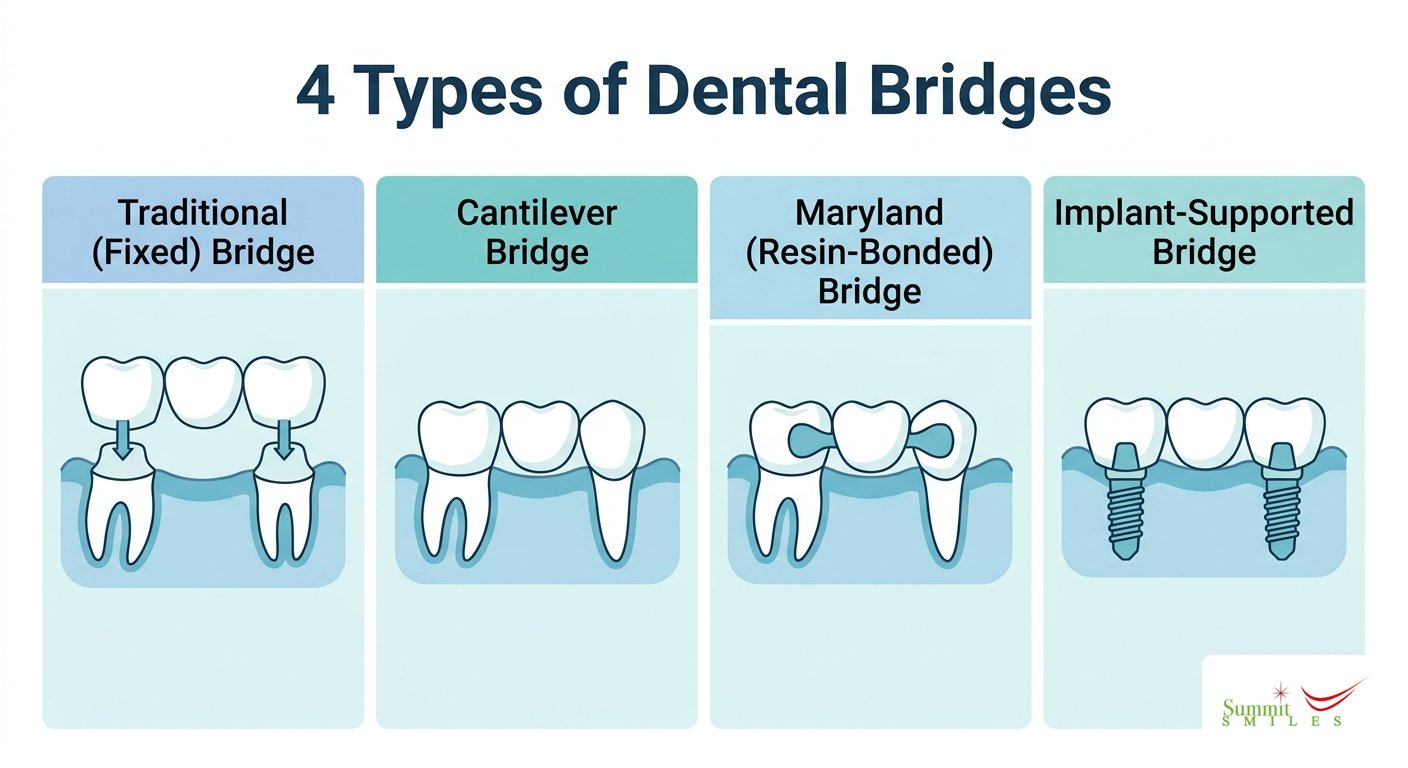
| Bridge Type | How It Anchors | Best Suited For |
|---|---|---|
| Traditional | Crowns cemented to a natural tooth on each side of the gap | A gap with healthy natural teeth on both sides |
| Cantilever | A crown cemented to a single natural tooth | A gap with only one healthy neighboring tooth |
| Maryland | A metal or porcelain framework bonded to the back of neighboring teeth | A gap where preserving more of the neighboring teeth matters |
| Implant-supported | Dental implants placed surgically in the jawbone | Multiple missing teeth without strong neighboring teeth to anchor to |
Bridge Materials: Porcelain, Metal, and Porcelain-Fused-to-Metal
Bridge materials fall into three categories, and each one balances strength, appearance, and cost differently. All-porcelain bridges blend in most closely with your natural teeth and suit a visible gap in the front of your mouth. Metal bridges resist wear better than porcelain and suit a back-tooth gap where appearance matters less than durability. Porcelain-fused-to-metal bridges combine a metal substructure with a porcelain outer layer, balancing the strength of metal with a more natural-looking surface, and remain one of the most commonly placed bridge materials for both front and back teeth.
| Material | Appearance | Durability | Best Suited For |
|---|---|---|---|
| All-porcelain | Closest match to natural teeth | Good, more prone to chipping under heavy bite force | A visible gap toward the front of your mouth |
| Metal | Least natural-looking | Highest resistance to wear and chipping | A back-tooth gap where strength matters most |
| Porcelain-fused-to-metal | Natural-looking outer layer | Strong metal core with a porcelain surface | Front or back teeth needing both strength and appearance |
When a Bridge Is the Right Choice
A bridge is the right choice when you have one or more missing teeth, healthy neighboring teeth or implants to anchor to, and a preference for a fixed restoration over implant surgery or a removable denture. Patients who want to avoid a second surgical procedure, who have a tight timeline before an event, or whose neighboring teeth already need crowns for other reasons often find a bridge fits their case well. Patients missing several teeth in a row, or an entire arch, are usually better served by a partial or complete denture, or by implant-supported options built for that scale of tooth loss.
Serving La Habra and Orange County
Summit Smiles serves patients from La Habra and the surrounding Orange County communities from our office at 305 E La Habra Blvd, inside the Lambert Plaza Business Center. Patients regularly travel to our office from Whittier, Fullerton, Brea, and Yorba Linda for restorative dentistry, including dental bridges, alongside the rest of our general and cosmetic services.
New Bridge Patients in La Habra
New bridge patients in La Habra start with a consultation where Dr. Shah examines the gap, reviews a 3D CBCT scan if needed, and discusses which bridge type fits your case. Bring a list of your current medications and your insurance information to your first visit so our team can verify your benefits before any treatment begins. Same-day and emergency appointments are available for patients dealing with a broken tooth, a lost filling, or a bridge-related emergency.
Dental Bridges FAQs
Where can I get a dental bridge near me in La Habra?
Summit Smiles places dental bridges at our La Habra office, located at 305 E La Habra Blvd inside the Lambert Plaza Business Center. Call (562) 262-8380 to schedule a consultation with Dr. Shah.
How much does a dental bridge cost, and does insurance help?
[bridge price range]. Many PPO and HMO plans cover a portion of the cost, and our team verifies your specific benefits before treatment starts. CareCredit financing is also available.
How long does a dental bridge last?
As stated by the American Association of Oral and Maxillofacial Surgeons, a fixed bridge typically needs replacement every seven to fifteen years, depending on daily care and regular dental visits.
How soon after a tooth extraction can I get a bridge?
[practice-specific extraction-to-placement waiting period]. Many practices wait roughly eight to twelve weeks for the extraction site and jawbone to heal first; Dr. Shah will confirm the right timeline for your case at your consultation.
Can a tooth get infected under a bridge?
Yes, if food and bacteria build up between the bridge and the gum line without proper daily flossing. Good oral hygiene, meaning regular brushing, flossing under the pontic, and routine dental care, prevents the tooth decay that can otherwise develop under a bridge.
What is the downside of a dental bridge?
A traditional or Maryland bridge requires reshaping healthy neighboring teeth, and a bridge does not stop the natural bone loss that follows a missing tooth the way a dental implant can.
What is cheaper, a dental implant or a bridge?
As per the American College of Prosthodontists, a single-tooth implant typically costs almost the same as a fixed bridge, so the right choice usually depends on candidacy and preference rather than cost alone.
Financing and Insurance
Financing and insurance options at Summit Smiles include most major PPO and HMO dental plans, plus CareCredit financing for patients who prefer predictable monthly payments. Visit our Insurance and Financing page for the full list of accepted plans and current financing terms.
Related Articles
Read more about restoring your smile with related procedures at Summit Smiles.



Comprehensive Care
Summit Smiles also offers Dental Crowns, Dentures, Dental Implants, and Root Canal Treatment for patients who need a complementary or alternative restoration.
Missing one or more teeth affects far more than a smile; it changes how you chew, how you speak, and how your remaining teeth wear over time. Summit Smiles built this page to give La Habra patients a real, honest comparison between a bridge, an implant, and a denture, so you can walk into a consultation already informed. Dr. Amit Shah and our in-house endodontic specialist, Dr. Meghna Patel, handle every step of bridge treatment under one roof, from an infected abutment tooth to the final cementation. Call (562) 262-8380 or schedule an appointment online to find out which bridge fits your case.
Insurance coverage for dental bridges varies by plan and can change at any time. Confirm your specific coverage and benefits directly with your insurance provider before treatment begins.